UNIDENTIFIED SUBJECT
Edged Weapon (Long-bladed Knife)
Whitechapel / Spitalfields, London, England
Destitute Women / Sex Workers
August 31 – November 9, 1888
5 “Canonical” Homicides
HISTORICAL COLD CASE // UNSOLVED
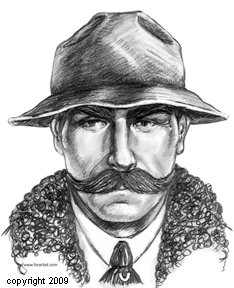
The psychological profiling of Jack the Ripper began contemporaneously with the crimes, largely through the groundbreaking work of police surgeon Dr. Thomas Bond. Bond concluded that the killer was a man of solitary habits, subject to periodic attacks of “homicidal and erotic mania.” The mutilations were not random but indicated an organized, deep-seated sexual pathology, even though physical sexual assault was absent from the crime scenes.
There remains fierce historical debate over the perpetrator’s level of anatomical knowledge. Some coroners argued the swift removal of organs in near-total darkness required the skill of a trained surgeon or butcher. Others, including Dr. Bond, argued the mutilations lacked precise anatomical technique, suggesting a killer driven by frenzied compulsion rather than clinical surgical intent.
August 31 & September 8 // Nichols and Chapman: The spree began with Mary Ann Nichols in Buck’s Row, followed a week later by Annie Chapman in the backyard of 29 Hanbury Street. Both women suffered deep throat lacerations and escalating abdominal mutilations, alerting police to a highly specific serial predator.
September 30 // The “Double Event”: The killer’s timeline was disrupted. Elizabeth Stride was found with her throat cut in Dutfield’s Yard, but lacking abdominal mutilation, suggesting the killer was interrupted. Less than an hour later, a short walk away, Catherine Eddowes was discovered in Mitre Square, severely mutilated, with her left kidney and uterus removed.
November 9 // Mary Jane Kelly: The horrific climax. Unlike the others, Kelly was murdered indoors, in the privacy of her own room at 13 Miller’s Court. Granted hours alone with the victim rather than minutes in an alleyway, the perpetrator performed an unprecedented and total evisceration of the body.
- Exhibit A (The “From Hell” Letter): Received by George Lusk of the Whitechapel Vigilance Committee in October 1888. It contained half of a preserved human kidney. While hundreds of hoax letters were sent (including the famous “Dear Boss” letter that coined the name Jack the Ripper), this is widely considered the only authentic correspondence.
- Exhibit B (The Goulston Street Graffito): Discovered near a piece of Catherine Eddowes’ bloodied apron following the Double Event. Chalk text on a wall read: “The Juwes are the men that will not be blamed for nothing.” Police Commissioner Sir Charles Warren ordered it erased before dawn, fearing anti-Semitic riots, destroying potential forensic evidence.
- Exhibit C (Victimology): The victims shared distinct characteristics—middle-aged (except Kelly), destitute women driven to episodic prostitution for the price of a bed (“fourpence”). The killer exploited the dire economic desperation of the East End.
- Exhibit D (Coronial Reports): Dr. George Bagster Phillips and Dr. Thomas Bond’s detailed autopsy notes remain the foundational bedrock of all modern Ripperology, establishing the left-to-right throat slash and the specific removal of organs.
The Ripper’s modus operandi relied on the complete trust and vulnerability of his victims. He likely strangled the victims into unconsciousness first (as evidenced by a lack of defensive wounds and blood spray on the front of their clothing), lowering them to the ground before cutting their throats left-to-right down to the spine to ensure rapid exsanguination and silence.
The post-mortem signature was extreme abdominal mutilation. Using a strong, sharp blade (at least 6-8 inches long), the killer made rapid, deep incisions to expose the abdominal cavity. The ritualistic removal of specific organs (kidneys, uterus, heart) in near-darkness within a span of roughly 5 to 15 minutes indicates an organized offender acting under an intense, escalating psychosexual compulsion.
- Witness Testimonies: Highly contradictory. Several witnesses (such as Joseph Lawende and George Hutchinson) reported seeing victims with men shortly before their deaths. Descriptions generally converged on a man of “shabby-genteel” appearance, aged between 20 and 40, wearing a dark coat and a felt deerstalker or peaked cap.
- Montague John Druitt: A dismissed schoolmaster who committed suicide in the Thames shortly after the Mary Jane Kelly murder. Named as a top suspect in the Macnaghten Memoranda, though modern criminologists doubt his involvement due to a lack of direct evidence.
- Aaron Kosminski: A Polish-Jewish immigrant who lived in Whitechapel and suffered from severe schizophrenia. Identified as a strong suspect by high-ranking police officials (Anderson and Swanson), he was committed to an insane asylum in 1891.
- Severin Klosowski (George Chapman): A Polish serial killer operating in London shortly after the Ripper murders. While he had medical knowledge and lived in Whitechapel, his later crimes utilized poison, a radical shift in M.O. that makes his candidacy debated.
The Whitechapel murders fundamentally changed the nature of criminal investigation and the media. It was arguably the first serial killer case to unfold in the era of mass media and daily newspapers, creating a blueprint for the sensationalized, tabloid true-crime reporting that exists today.
Systemically, the murders shone a blinding light on the horrific squalor, overcrowding, and desperation of the East End. The public outcry over the murders inadvertently acted as a catalyst for social reform, leading to the clearing of some of the worst slums and the eventual establishment of better housing and welfare programs for London’s most destitute citizens.
While the official Whitechapel murders file contains 11 deaths, historical and forensic consensus generally restricts the Ripper’s victims to the “Canonical Five”:
| Victim Name | Age | Date & Location of Discovery |
|---|---|---|
| Mary Ann Nichols (“Polly”) | 43 | August 31, 1888 (Buck’s Row) |
| Annie Chapman (“Dark Annie”) | 47 | September 8, 1888 (29 Hanbury St) |
| Elizabeth Stride (“Long Liz”) | 44 | September 30, 1888 (Dutfield’s Yard) |
| Catherine Eddowes | 46 | September 30, 1888 (Mitre Square) |
| Mary Jane Kelly | c. 25 | November 9, 1888 (13 Miller’s Court) |