CARL “CHARLES” WEBB
Suspected Toxin (Undetected)
Somerton Park, Adelaide, Australia
Unexplained Death / Possible Suicide
December 1, 1948
1 Confirmed Fatality
IDENTIFIED // CAUSE UNSOLVED
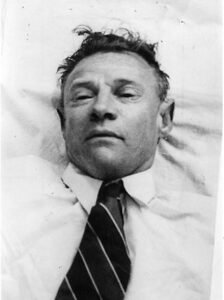
On the morning of December 1, 1948, the body of a well-built, middle-aged man was discovered slumped against a seawall at Somerton Park beach. He was impeccably dressed in a suit, tie, and polished shoes—highly unusual attire for the beach. There were no signs of physical struggle, trauma, or robbery. An unlit cigarette rested on his collar.
The immediate forensic anomaly was the active erasure of his identity. Every single manufacturer’s tag had been meticulously cut from his clothing. He carried no wallet, no identification, and no keys. Dental records and fingerprints yielded zero matches across all Australian and international databases. He was a complete ghost, leading to decades of wild speculation that he was a Cold War spy assassinated on Australian soil.
November 30, 1948: The man arrives at Adelaide Railway Station, purchases a ticket to Henley Beach (which he does not use), and checks a brown suitcase into the station’s cloakroom.
January 1949 // The Suitcase Discovery: Police locate his abandoned suitcase. Like his clothing, the tags on the garments inside have been removed. It contains an electrician’s screwdriver, a stenciling brush, and a distinctive orange Barbour thread—the exact thread used to repair a pocket on the trousers he was wearing when found.
April 1949 // The Tamám Shud Slip: A pathologist re-examining the body discovers a tiny, tightly rolled piece of paper hidden deep within a secret fob pocket in the man’s trousers. The scrap contains two printed words: “Tamám Shud” (Persian for “It is finished”).
July 1949 // The Book & The Code: A local man turns in a rare copy of the Rubaiyat of Omar Khayyam, found tossed into his car near Somerton Beach. The torn slip perfectly matches a missing section on its final page. Under UV light, police discover an unlisted phone number and a cipher of seemingly random letters scribbled on the back cover.
- Exhibit A (The Cryptogram): The five lines of capital letters found on the book (e.g., WRGOABABD). For decades, military intelligence failed to crack it. Modern analysis suggests it is not an espionage cipher, but likely an acronymic memory aid, possibly for betting on horse racing or poetry verses.
- Exhibit B (Jessica “Jestyn” Thomson): The unlisted phone number in the book belonged to a young nurse living a short walk from where the body was found. When shown a plaster bust of the man by police, she appeared deeply distressed and nearly fainted, but adamantly denied knowing him. She remained a crucial, silent nexus of the mystery until her death.
- Exhibit C (Pathology Report): The autopsy revealed an acutely congested liver, enlarged spleen, and a stomach filled with blood and a recently eaten pasty. Chief pathologist Sir John Cleland suspected a highly soluble, untraceable poison—such as digitalis or strophanthin—but could not definitively prove it.
While initially treated as a homicide via clandestine poisoning (fueling the Soviet spy theories), the overarching circumstances strongly suggest a deliberate, methodical suicide. The removal of identification tags is a known, albeit rare, psychological behavior among suicides who wish to spare their families the trauma of discovery or simply wish to disappear from existence.
The presence of the Rubaiyat—a collection of poetry heavily focused on living life to the fullest and having no regrets at death—combined with the “Tamám Shud” slip specifically torn out and kept close to his person, acts as a profound, poetic suicide note. The physical distress to his internal organs aligns with the ingestion of a toxic cardiac glycoside, likely swallowed shortly after his arrival at the beach.
For over 70 years, the Somerton Man rested in an unmarked grave, the subject of books, documentaries, and global amateur sleuthing. The breakthrough finally arrived through modern genetic genealogy. In May 2021, the South Australian police exhumed his remains to extract DNA from a deeply embedded hair root.
In 2022, Professor Derek Abbott and forensic genealogist Colleen Fitzpatrick cross-referenced the DNA with millions of profiles on genealogical databases. They successfully traced his lineage, definitively identifying him as Carl “Charles” Webb, a 43-year-old electrical engineer and instrument maker from Melbourne.
The resolution dismantled the espionage theories. Webb was a man known to write his own poetry, suffered from a volatile temper, and had recently separated from his wife, Dorothy. It is now widely believed that Webb traveled to Adelaide to track down his estranged wife, or potentially Jessica Thomson, and, facing rejection or despair, consumed poison on the beach, closing the book on his own life.
| Victim Identity | Age | Date & Location of Discovery |
|---|---|---|
| Carl “Charles” Webb (The Somerton Man) | 43 | December 1, 1948 (Somerton Park Beach) |