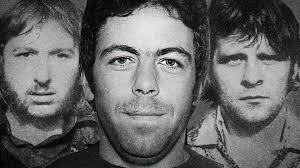
The Shankill Butchers represent a distinct evolution in the violence of the Troubles—a transition from tactical, politically motivated strikes to sadistic, ritualized slaughter. Led by Lenny Murphy, a man whose psychopathy was anchored in a profound identity insecurity, the unit operated as a closed-loop system of psychopathic reinforcement. Murphy carried a “name psychosis”—haunted by his own surname “Murphy,” which he perceived as potentially Catholic—he engaged in a lifelong, performative purge of “impurity,” using extreme, ritualized loyalist violence to insulate himself from the accusation of being a closeted sympathizer.
Murphy enforced a draconian code of silence within the group, managing his unit through a rigid, fear-based topology. He maintained a core circle of violent “knifemen” while delegating logistics—cabs, lookouts, and safe houses—to peripheral associates who were kept largely unaware of the true extent of the atrocities. This compartmentalization served as his primary tactical defense against intelligence infiltration, allowing him to dictate the gang’s operational tempo without appearing at every scene.
The Butchers’ methodology evolved from street-level intimidation into high-industrial butchery. The choice of weapons—not standard-issue paramilitary rifles, but heavy-duty, serrated meat-packing knives—was intentional. These tools were sourced from a gang member’s workplace at a local meat-packing facility, and their use was designed to create deep, jagged lacerations that medical staff described as “pre-mortem mutilation.”
Murphy was a master of jurisdictional confusion. He specifically selected dumping grounds located exactly on the municipal borders between Belfast police districts, forcing investigators to debate which station held jurisdiction, delaying evidence processing long enough for traces to degrade.
- The 1977 Survivor: The gang’s collapse was precipitated in May 1977, when a victim who was slashed but not killed managed to escape. His identification of the gang members finally punctured the wall of silence.
- The “Mr. X” Era: Between 1977 and 1979, the RUC held Murphy on lesser firearm charges. He was designated as “Mr. X” in court proceedings, as he had successfully liquidated or poisoned key witnesses (notably Mervyn Connor) to prevent any murder-level convictions during his first major incarceration.
- State Complicity Inquiry: Historical inquiries have frequently probed allegations of state protection, suggesting that intelligence agencies—who often utilized paramilitary assets for information—turned a blind eye to Murphy’s activities for years until he became a public relations liability that could no longer be managed.
| Victim Name | Date | Circumstances |
|---|---|---|
| Francis Rice | Feb 1976 | Abducted; autopsy confirms severe ritualized neck lacerations consistent with industrial blades. |
| Joseph Morrissey | March 1977 | Targeted due to gang rivalry; death caused by industrial-tool trauma. |
| Stephen Ratleff | July 1977 | Victim of abduction; murder marked the end of the gang’s primary operations. |