PETER THOMAS MANUEL
Firearms (Webley Revolver) / Blunt Trauma / Strangulation
Lanarkshire & Glasgow, Scotland
Sleeping Families / Young Women (Opportunistic)
January 1956 – January 1958
7 Convicted Homicides (9 Suspected)
DECEASED // EXECUTED
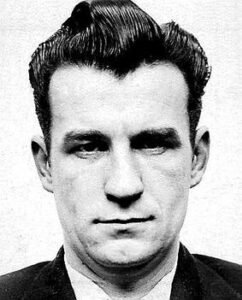
Born to Scottish parents in the United States before returning to Scotland, Peter Thomas Manuel developed a severe criminal record from early adolescence, escalating rapidly from housebreaking and theft to brutal sexual assaults. Early psychiatric evaluations identified him as an incurable psychopathic personality. He was entirely devoid of empathy, operating strictly on impulse, ego, and a craving for notoriety.
Unlike stealth-oriented serial predators who avoid law enforcement, Manuel was driven by profound arrogance. He actively inserted himself into police investigations, acting as an informant and feeding detectives deliberate misinformation. He thrived on the belief that he was intellectually superior to the Scottish police force, a delusion that fueled his recklessness and ultimately secured his downfall.
January 1956 // Anne Kneilands: The spree began with the brutal bludgeoning of 17-year-old Anne Kneilands on a golf course in East Kilbride. Manuel was brought in for questioning but escaped arrest due to a false alibi provided by his father.
September 1956 // The Watt Family: Escalating to armed home invasion, Manuel broke into a house in Burnside and executed Marion Watt, her 16-year-old daughter Vivienne, and Marion’s sister, Margaret Brown, using a stolen firearm. He subsequently framed Marion’s husband, William Watt, who spent 67 days in Barlinnie Prison before Manuel’s later actions cleared him.
December 1957 // Isabelle Cooke: Seventeen-year-old Isabelle disappeared while walking to a local dance in Uddingston. Manuel stalked, murdered, and buried her in a nearby field.
January 1958 // The Smart Family: Days after murdering Cooke, Manuel broke into the Uddingston home of Peter and Doris Smart, executing them and their 10-year-old son Michael while they slept. Displaying extreme psychopathy, Manuel remained in their home for days after the murders, eating their food, feeding the family cat, and driving Peter Smart’s car.
- Exhibit A (The Webley Revolver): Ballistics confirmed that the same stolen Webley .38 revolver was used in both the Watt and Smart family massacres, proving a single perpetrator was orchestrating the home invasions.
- Exhibit B (The Crisp Banknotes): Following the Smart family murders, Manuel carelessly spent distinct, brand-new £1 notes at local pubs. Bank records proved Peter Smart had recently withdrawn these exact consecutive notes to pay for a family holiday, providing a direct financial link to Manuel.
- Exhibit C (The Confession & Topography): Once arrested, Manuel’s ego compelled him to confess. To prove his intelligence, he physically directed police to the exact location where he had buried Isabelle Cooke and where he had discarded Anne Kneilands’ shoes—details only the killer could know.
- Exhibit D (Trophies): Manuel gifted a watch stolen from one of his victims to his father, physically cementing his connection to the stolen property of the deceased.
Manuel’s modus operandi was notably erratic, a rare trait in serial offenders. He alternated between violent, disorganized outdoor blitz attacks against vulnerable young women and highly organized, tactical home invasions where he executed multiple sleeping victims at close range with a firearm.
His behavioral signature was his post-offense audacity. He stole from his victims, drove their cars around the community, and even temporarily lived alongside their corpses. His need to exert dominance extended to law enforcement; he engaged in a dangerous cat-and-mouse game, holding secret meetings with detectives and his victims’ relatives (such as William Watt) to flaunt his insider knowledge under the guise of an informant.
- Physicality & Demeanor: A charismatic, sharply dressed 31-year-old who relied heavily on his persuasive abilities. He presented himself as a knowledgeable, formidable local figure with alleged ties to the criminal underworld.
- Courtroom Theatrics: In an ultimate display of pathological narcissism, Manuel fired his highly respected defense counsel during his capital trial and chose to represent himself. He cross-examined police officers and witnesses, attempting to turn the trial into a grand theatrical spectacle to showcase his intellect.
- Custodial Resolution: The jury was unconvinced by his theatrics, taking just over two hours to find him guilty. On July 11, 1958, Peter Manuel was hanged at Barlinnie Prison in Glasgow by executioner Harry Allen, becoming the third-to-last criminal to be executed in Scotland.
The Peter Manuel spree plunged 1950s Scotland into a state of unprecedented terror. The extreme violence of the home invasions, combined with the apparent randomness of the victims, caused near-hysteria in Lanarkshire and Glasgow. Citizens who rarely locked their doors began heavily barricading their homes at night.
The case also highlighted the severe dangers of investigative tunnel vision. The premature arrest of William Watt for the murder of his own family—based largely on circumstantial evidence and pressure to close the case—allowed Manuel to remain free to kill four more people. Manuel’s capture, dramatic trial, and execution remain a landmark in Scottish legal history, heavily studied for its pure exhibition of psychopathic grandiosity.
The seven victims for whose murders Peter Manuel was officially convicted and executed:
| Victim Name | Age | Date & Location of Death |
|---|---|---|
| Anne Kneilands | 17 | January 2, 1956 (East Kilbride) |
| Marion Watt | 45 | September 17, 1956 (Burnside) |
| Vivienne Watt | 16 | September 17, 1956 (Burnside) |
| Margaret Brown | 41 | September 17, 1956 (Burnside) |
| Isabelle Cooke | 17 | December 28, 1957 (Uddingston) |
| Peter Smart | 45 | January 1, 1958 (Uddingston) |
| Doris Smart | 42 | January 1, 1958 (Uddingston) |
| Michael Smart | 10 | January 1, 1958 (Uddingston) |
Note: Manuel also confessed to the murders of Sydney Dunn (36) in England and Anne Kneilands (listed above, though he was officially convicted of the other seven), cementing his legacy as one of the UK’s most prolific killers of the era.