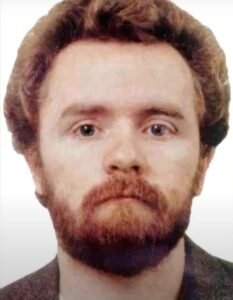
 John Duffy
John Francis Duffy grew up in Kilburn, North London, where he developed a tight childhood friendship with David Mulcahy. Outwardly maintaining a quiet, submissive, and unassuming persona, Duffy secured employment as a carpenter for British Rail, which provided him with specialized geographic knowledge of London’s intricate network of tracks and maintenance routes. His domestic life was intensely volatile, culminating in a bitter marital separation marked by severe physical domestic abuse and erratic behavior.
Psychologically, Duffy possessed a highly calculation-driven, sadistic personality structure. When operating alongside Mulcahy, he assumed an aggressive dominant posture, orchestrating a series of increasingly violent sexual assaults across the rail network that ultimately escalated into cold-blooded executions. Following his arrest, forensic psychiatrists noted that his compulsion to completely dominate, terrorize, and silence his victims was deeply tied to profound feelings of personal and sexual inadequacy.
Duffy’s operational method was uniquely transit-based. Operating primarily under the cover of darkness or during late evening commutes, he and Mulcahy patrolled the perimeters of train stations, footbridges, and isolating pathways flanking railway tracks in the London outskirts. They targeted lone women disembarking from trains, executing sudden, high-speed physical ambushes from behind bushes or dark corners before drag-routing them down isolated railway embankments.
To ensure compliance and suppress defensive screaming, Duffy weaponized large blades—frequently deploying a machete or hunting knife—and bound his victims with highly specific materials, such as electric wire or string. When the assaults escalated to murder in 1985 and 1986, his execution signature transformed into swift, brutal ligature strangulation or deep throat cuts. Following the murders, Duffy utilized an aggressive counter-forensic protocol, systematically dousing the victims’ bodies and garments in heavy concentrations of household hair adaptors or industrial cleaning agents to chemically degrade his biological trace evidence and destroy genetic configurations before the items could reach laboratory teams.
- The Breakthrough of Offender Profiling: Confronted by a massive web of cross-jurisdictional offenses across separate police boundaries, Scotland Yard engaged clinical psychologist Professor David Canter. Canter analyzed the spatial, geographical data logs and behavioral signatures of the crimes, generating an incredibly accurate behavioral profile that specified the killer was a right-handed Londoner with a history of domestic separation who worked near the railway grid.
- The Suspect Matrix: Investigators cross-referenced Canter’s descriptive psychological profile against an expansive list of 2,000 potential suspects. The behavioral matrix successfully isolated John Duffy, narrowing him down to a primary group of just a few individuals.
- The Surgical Twine Match: During a tactical search of Duffy’s residence following his 1986 arrest, detectives recovered a highly specific, rare type of paper-wrapped surgical twine. Forensic materials scientists verified that the twine’s physical characteristics matched the rare cords used to bind murder victim Alison Shaughnessy, delivering an ironclad forensic link that secured his conviction long before modern DNA amplification methods were fully deployed.
1982–1985 // The Assault Campaign: Duffy and Mulcahy launch a systematic campaign of coordinated knife-point sexual assaults against women near regional transit stops, confusing cross-border police teams.
December 29, 1985 // Alison Shaughnessy: A 19-year-old clerk is abducted from a railway staircase in Virginia Water, assaulted, and strangled with a ligature; her body is chemically treated to suppress trace evidence.
April 17, 1986 // Maartje Tamboezer: A 15-year-old Dutch student is ambushed while cycling near a railway line in Horsley. She is assaulted and executed; Duffy attempts to burn her body to destroy physical tracks.
May 18, 1986 // Anne Lock: A television researcher is abducted after disembarking from a train at Brookmans Park. Her body is recovered inside a thick woodland perimeter adjacent to the tracks several months later.
November 1986 // Tactical Apprehension: Following intensive physical surveillance triggered by the suspect matrix, police intercept Duffy, seizing physical rope items from his storage spaces.
February 1988 // The Old Bailey Trial: Relying heavily on psychological profiling data and materials analysis, a jury finds Duffy guilty of two murders and multiple violent assaults. He receives a life sentence with a 30-year minimum.
1997–2000 // The Mulcahy Unmasking: While incarcerated, Duffy breaks his decade-long silence during prison therapy, officially implicating his childhood friend David Mulcahy. Following a secondary modern DNA cold-case trial, Mulcahy receives three life orders in 2000, bringing full closure to the Railway spree.
The successful tracking and conviction of John Duffy remains one of the most celebrated milestones in the history of global criminology. Prior to this case, British law enforcement viewed offender profiling with extreme skepticism, often dismissing it as an unscientific, experimental gimmick. Professor David Canter’s ability to extract an accurate, highly descriptive biographical roadmap solely from geographical data points and crime scene staging dynamics completely revolutionized police methods across the UK.
The case served as the absolute catalyst for the creation of modern **Investigative Psychology** as a formal scientific discipline. The Home Office subsequently poured substantial funding into developing advanced geographical profiling software and unified data networks, giving birth to the **ViCLAS** (Violent Crime Linkage Analysis System) architecture. This system ensures that cross-jurisdictional violent acts are instantly mapped across regional borders, permanently preventing mobile actors like the Railway Killers from exploiting communication blind spots between regional police forces.
| Victim Name | Date | Context of Fatality |
|---|---|---|
| Alison Shaughnessy (19) | December 29, 1895 | Abducted near a staircase at Virginia Water station. Bound with twine, sexually assaulted, and strangled; body subjected to chemical trace suppression. |
| Maartje Tamboezer (15) | April 17, 1986 | Dutch student ambushed while cycling near East Horsley station. Strangled with a wire ligature; perpetrator executed a partial scene cremation to clear physical evidence. |
| Anne Lock (29) | May 18, 1986 | London television worker intercepted at Brookmans Park station after finishing her shift. Suffocated and hidden within a remote woodland clearing. |