JOHN REGINALD HALLIDAY CHRISTIE
Toxic Gas (Carbon Monoxide) / Ligature Strangulation
London, England (Notting Hill)
Vulnerable Women / Lodgers / Own Family
August 1943 – March 1953
8 Confirmed Homicides
DECEASED // EXECUTED
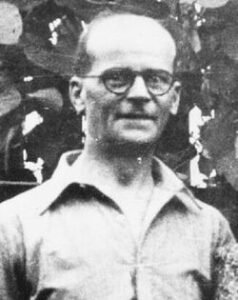
John Christie was an unassuming, balding, and seemingly mild-mannered man who spoke in a distinctive whisper, which he falsely attributed to a mustard gas attack during the First World War. Beneath this frail, hypochondriacal exterior lay a highly organized, sexually sadistic predator with a profound necrophilic pathology.
Christie possessed a deep-seated need for absolute control, which he masked behind a veneer of authority. During World War II, he served as a Special Constable in the War Reserve Police, a position he weaponized to gain the trust of marginalized women. He further cultivated a false identity as a medically knowledgeable benefactor, offering illegal abortions or “cures” for various ailments, luring desperate women into his ground-floor flat at 10 Rillington Place.
August 1943 // Ruth Fuerst: Christie’s first known victim. An Austrian munitions worker and part-time prostitute, she was strangled and buried in the small back garden of Rillington Place.
November 1949 // Beryl and Geraldine Evans: The catalyst for a historic miscarriage of justice. Christie murdered his upstairs tenant, Beryl Evans, under the pretense of performing a back-alley abortion. He subsequently murdered her 13-month-old infant daughter, Geraldine. Christie masterfully manipulated the police investigation, resulting in Beryl’s husband, Timothy Evans, being wrongfully hanged for the crimes in 1950.
December 1952 // Ethel Christie: Escalating his control of the property, Christie murdered his own wife, Ethel, hiding her body beneath the floorboards of the front room. Her death removed the last barrier to his predatory impulses.
March 24, 1953 // The Alcove Discovery: Having run out of funds, Christie sublet his flat and fled. The new tenant, Beresford Brown, stripped wallpaper in the kitchen to install a shelf, discovering a hollow alcove containing the hidden, stacked bodies of three missing women.
- Exhibit A (The Kitchen Alcove): A modified, sealed coal bunker behind the kitchen wall where police found the bodies of Hectorina Maclennan, Kathleen Maloney, and Rita Nelson, all wrapped in blankets and stacked meticulously.
- Exhibit B (The Gassing Apparatus): A rubber tube rigged to the domestic coal gas line. Christie had modified it with a bulldog clip to act as a rudimentary valve, allowing him to secretly pump carbon monoxide into the room to incapacitate victims before strangling them.
- Exhibit C (The Floorboards & Washhouse): The structural dismantling of the property revealed Ethel Christie hidden under the front room floorboards, and the earlier remains of Beryl and Geraldine Evans in the outdoor washhouse.
- Exhibit D (The Tobacco Tin): During the search, police discovered an old tobacco tin containing four separate collections of pubic hair, which Christie had harvested as anatomical trophies from his victims.
Christie’s M.O. was uniquely calculated to minimize struggle and maximize his control. He used a specialized form of sedation, convincing women to breathe from a tube attached to a jar of “special mixture” (e.g., friar’s balsam), which was secretly spliced into the highly toxic domestic coal gas supply. Once the victim was unconscious from carbon monoxide poisoning, Christie strangled them with a ligature, often a piece of rope or a stocking.
Forensic pathology revealed a dark post-mortem signature: Christie engaged in necrophilia immediately following the murders. He did not dispose of the bodies externally; his pathology required him to hoard them. He entombed his victims within the walls, under the floorboards, and in the small garden of 10 Rillington Place, literally living surrounded by the decomposing evidence of his crimes.
- Physicality: A slender, unassuming man with a receding hairline and prominent glasses. His most notable feature was his quiet, breathy whisper, which forced victims to lean in close to hear him, inadvertently placing them in his personal space.
- Criminal Background: Prior to his murders, Christie possessed a lengthy criminal record spanning decades, including convictions for theft, assault, and malicious wounding (striking a prostitute in the head with a cricket bat).
- Interrogation Behavior: Upon his arrest by a sharp-eyed police officer near Putney Bridge in 1953, Christie confessed rapidly to the murders in the alcove. He later confessed to the murder of Beryl Evans, actively dismantling the prosecution’s case against the already executed Timothy Evans.
- Custodial Resolution: Christie’s defense of insanity was rejected by the jury in just 85 minutes. He was sentenced to death and hanged by executioner Albert Pierrepoint at Pentonville Prison on July 15, 1953.
Timothy Evans: Christie’s upstairs lodger. A highly suggestible man with a low IQ, Evans was manipulated by the police into falsely confessing to the murders of his wife Beryl and daughter Geraldine—crimes actually committed by Christie. Evans was hanged in 1950, three years before Christie’s true nature was exposed.
Ludovic Kennedy: An investigative journalist and author whose exhaustive 1961 book, Ten Rillington Place, systematically dismantled the police investigation that convicted Evans. Kennedy’s work proved that Christie was the sole architect of the Evans murders and exposed the systemic failures of the British justice system.
The legacy of John Christie is inexorably tied to the tragic fate of Timothy Evans. The revelation that the state had hanged an innocent man, while the true serial killer testified against him in court, caused an unparalleled public outcry. It completely undermined British public confidence in capital punishment.
Following two official inquiries, Timothy Evans was granted a posthumous royal pardon in 1966. The sheer horror of the miscarriage of justice directly accelerated the passing of the Murder (Abolition of Death Penalty) Act 1965, effectively ending executions in the United Kingdom. As for the property, 10 Rillington Place was eventually demolished, and the street was renamed and rebuilt in an attempt to erase the geographic scar of the crimes.
The eight known victims discovered entombed within the confines of 10 Rillington Place:
| Victim Name | Estimated Date of Death | Concealment Location |
|---|---|---|
| Ruth Fuerst | August 1943 | Back Garden |
| Muriel Eady | October 1944 | Back Garden |
| Beryl Evans | November 1949 | Outdoor Washhouse |
| Geraldine Evans (13 mos) | November 1949 | Outdoor Washhouse |
| Ethel Christie (Wife) | December 1952 | Front Room Floorboards |
| Rita Nelson | January 1953 | Kitchen Alcove |
| Kathleen Maloney | January 1953 | Kitchen Alcove |
| Hectorina Maclennan | March 1953 | Kitchen Alcove |