HOWARD BARTON UNRUH
9mm Luger P08 Pistol
Cramer Hill, Camden, New Jersey, USA
Neighbors / Local Shopkeepers / Passersby
September 6, 1949
13 Confirmed Homicides (3 Injured)
DECEASED // FOUND NOT GUILTY BY INSANITY
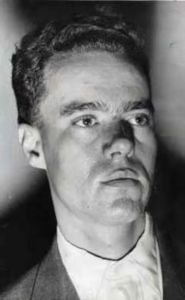
Born in 1921, Howard Unruh was a quiet, taciturn loner who served his country with distinction as a tank gunner and sharpshooter across Europe during World War II, seeing action at the Battle of the Bulge. After returning from the war, he lived with his mother in a working-class neighborhood in East Camden, New Jersey, where he became increasingly isolated.
Unruh suffered from paranoid schizophrenia. His rigid temperament left him unable to handle frustration or perceived interpersonal slights, leading to extreme paranoia. He maintained a mental hit list of local shopkeepers—including a druggist, shoemaker, and tailor—whom he believed were actively making derogatory remarks about his character.
September 5, 1949 // The Catalyst: Unruh returned home at 3 a.m. from a Philadelphia movie theater to discover that a backyard gate he had recently built to avoid neighbors had been tampered with and removed. This perceived aggression finalized his decision to strike.
September 6, 1949 (Morning) // The Escalation: Unruh cornered his mother with a monkey wrench, threatening her until she fled the apartment in terror.
9:20 a.m. – 9:32 a.m. // The Walk of Death: Armed with his souvenir 9mm Luger, Unruh embarked on a 12-minute walk along the 3200 block of River Road. He fired into moving cars, the local pharmacy, a barber shop, and a tailor shop, executing 13 people, including three children.
9:32 a.m. // The Siege: Unruh retreated and barricaded himself inside his apartment. A massive shootout with approximately 60 police officers ensued, concluding only after police deployed tear gas into the residence and Unruh surrendered following a gunshot wound to his hip.
- Exhibit A (The Murder Weapon): A 9mm German Luger, which Unruh brought back to the United States as a World War II souvenir.
- Exhibit B (The Basement Range): Police discovered an improvised shooting range in Unruh’s mother’s basement, where he practiced firing from a kneeling position to maintain his military-grade marksmanship.
- Exhibit C (The Confession): Unruh readily confessed to the murders, citing his deteriorating relationships with his neighbors as his primary motive.
- Exhibit D (The Hit List): An intense, premeditated mental ledger composed of the local druggist, shoemaker, tailor, and restaurant owner whom Unruh sought to explicitly target during his rampage.
Unlike serial killers who operate in secret over long periods, Unruh’s crime was an explosive, highly visible mass casualty event. He possessed the combat expertise required to systematically clear local storefronts.
His M.O. combined targeted grievances with devastating collateral damage. For instance, he shot a six-year-old boy simply because the child was sitting in the barber shop where Unruh aimed to kill the barber.
- Physicality & Demeanor: A 28-year-old former soldier considered by his employers and peers to be a quiet, diligent, and inconspicuous individual who rarely caused trouble.
- Psychiatric Evaluation: Evaluators determined he suffered from deep-seated paranoia and schizophrenia, heavily complicated by his inability to socially integrate following his military service.
- Custodial Resolution: Diagnosed as legally insane, Unruh was immune to criminal prosecution and was involuntarily committed to the New Jersey State Hospital.
- Death: He remained confined for over 60 years, eventually dying in a Trenton nursing facility following an extended illness on October 19, 2009, at the age of 88.
The “Walk of Death” stunned the American public and is widely regarded as the first example of a mass shooting by a lone gunman in the United States following World War II. The incident introduced the nation to the terrifying, modern phenomenon of the “mass murderer”.
The Camden shootings stood as the deadliest mass shooting in the country, in terms of fatalities, until the 1966 University of Texas tower shooting. The tragedy foreshadowed an era in which such sudden, heavily armed domestic violence would become increasingly common.
The 13 victims who lost their lives to Howard Unruh during the 12-minute rampage on September 6, 1949:
| Victim Name | Age |
|---|---|
| John Joseph Pilarchik | 27 |
| Orris Martin Smith | 6 |
| Clark Ronald Hoover | 33 |
| James Winfield Hutton | 46 |
| Rose Fine Cohen | 38 |
| Minnie Cohen | 63 |
| Dr. Maurice J. Cohen | 41 |
| Alvin Day | 24 |
| Thomas Hamilton | 2 |
| *Plus 4 additional adult victims | N/A |