STEPHAN BALLIET
Homemade Firearms (Submachine Gun / Shotguns) / IEDs
Halle (Saale), Saxony-Anhalt, Germany
Jewish Congregants / Ethnic Minorities
October 9, 2019
2 Confirmed Homicides (2 Injured)
INCARCERATED // LIFE SENTENCE
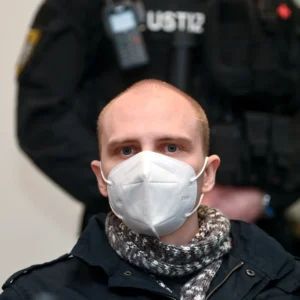 Stephan Balliet
Stephan Balliet was a 27-year-old lone-wolf extremist deeply entrenched in internet subcultures, particularly anonymous imageboards. Socially isolated and living with his mother, he was heavily radicalized by a toxic cocktail of virulent anti-Semitism, white supremacy, and misogyny. He sought to emulate the perpetrators of the Christchurch mosque shootings and the Poway synagogue attack.
Balliet’s pathology was heavily characterized by the “gamification” of terror. He did not merely want to commit a massacre; he wanted an audience. To achieve this, he equipped a helmet-mounted camera to livestream his assault directly to the gaming platform Twitch, treating the real-world attack as a first-person shooter game where he could achieve specific “objectives” laid out in his online manifesto.
12:00 p.m. // The Synagogue Breach Attempt: Heavily armed and broadcasting live, Balliet drives a rented car to the Halle Synagogue, where 51 congregants are observing Yom Kippur. He attempts to breach the heavy oak perimeter doors using improvised explosive devices and shotgun blasts. The reinforced doors hold firm. Frustrated, he attempts to enter through a courtyard but is repeatedly thwarted by the physical security.
12:03 p.m. // The First Homicide: As Balliet struggles with his jamming homemade weapons outside the synagogue, a 40-year-old passerby, Jana Lange, reprimands him for making noise. Balliet immediately turns and shoots her in the back. He continues to struggle with his malfunctioning weapons while checking on her body, displaying intense frustration on his livestream.
12:12 p.m. // The Kiez-Döner Assault: Realizing he cannot access his primary target, Balliet drives to a nearby kebab shop (Kiez-Döner) to target individuals he perceives as immigrants. He enters the shop and opens fire with his homemade submachine gun, which jams repeatedly. He manages to shoot a 20-year-old customer, Kevin Schwarze, leaves to retrieve another weapon, returns, and fatally shoots him again.
12:15 p.m. – 1:30 p.m. // The Escape and Capture: Fleeing the kebab shop, Balliet engages in a brief shootout with arriving police, sustaining a neck wound. He abandons his rental car, hijacks a taxi, and flees the city. Approximately an hour and a half later, following a collision with a truck near Zeitz, he is apprehended by police.
- Exhibit A (The Helmet Camera Footage): A 35-minute video livestreamed on Twitch. It provided an unedited, real-time forensic record of the attack, capturing Balliet’s anti-Semitic monologues, his repeated weapon malfunctions, and his visible frustration at failing his primary objective.
- Exhibit B (The Homemade Arsenal): Unable to legally acquire standard firearms, Balliet manufactured his own weapons using a 3D printer, steel pipes, and instructions found online. His primary weapon was a homemade replica of the Luty submachine gun. The severe unreliability and constant jamming of these weapons directly limited the fatality count.
- Exhibit C (The Manifesto): Uploaded shortly before the attack, the PDF document outlined his white supremacist ideology, listed his “achievements” (treating the attack like a video game), and detailed the schematics of his homemade weapons to inspire future copycat terrorists.
- Exhibit D (The Synagogue Door): The reinforced wooden door, riddled with bullet holes and blast marks, became the defining piece of evidence illustrating how robust physical security measures successfully prevented a catastrophic massacre.
Balliet’s operational signature was defined by the fusion of digital performative terrorism and DIY weapon manufacturing. His intent was highly calculated: he deliberately attacked on Yom Kippur, the holiest day in Judaism, to ensure maximum attendance at the synagogue.
His M.O. was entirely dependent on broadcasting his actions to a supportive online audience. However, the forensic reality of the attack highlighted a stark contrast between his grandiose digital fantasies and his practical incompetence. The repeated failure of his 3D-printed and improvised firearms demonstrated the current tactical limitations of homemade arsenals, though it successfully advertised a dangerous new vector for terrorist weapon procurement.
- Physicality & Demeanor: A 27-year-old male dressed in tactical combat gear and a helmet camera. During the attack, he frequently cursed at himself in English (catering to an international online audience) when his weapons failed, showing anger at his own incompetence rather than remorse for his victims.
- Courtroom Behavior: During his trial in Magdeburg, Balliet remained entirely unrepentant. He frequently smiled, smirked, and attempted to use the courtroom as a platform to further propagate his Holocaust denial and anti-Semitic conspiracies, forcing the judge to repeatedly silence him.
- Custodial Resolution: In December 2020, Stephan Balliet was found guilty of two counts of murder and 68 counts of attempted murder. He was sentenced to life in prison with subsequent preventive detention (Sicherungsverwahrung), ensuring he will likely never be released.
The Halle attack served as a dual wake-up call for European security agencies. First, it terrifyingly proved that the “gamification” of right-wing terror—where lone wolves compete for high scores and online infamy—was rapidly spreading across borders. Second, it demonstrated that strict gun control laws could be bypassed by determined individuals using 3D printers and rudimentary machining skills, forcing intelligence agencies to drastically increase monitoring of dark web blueprints and 3D printing communities.
Conversely, the incident stands as one of the most prominent modern testaments to the efficacy of target hardening. The lives of the 51 congregants inside the synagogue were unequivocally saved not by law enforcement intervention, but by the structural integrity of a reinforced door. This sparked widespread government funding across Europe to structurally fortify Jewish institutions and places of worship against active shooter and explosive threats.
The two innocent victims who lost their lives to Stephan Balliet after his primary objective was thwarted:
| Victim Name | Age | Location of Death |
|---|---|---|
| Jana Lange | 40 | Street outside Halle Synagogue |
| Kevin Schwarze | 20 | Kiez-Döner (Kebab Shop) |
Note: Two additional individuals sustained serious gunshot wounds during the perpetrator’s escape phase but survived their injuries.