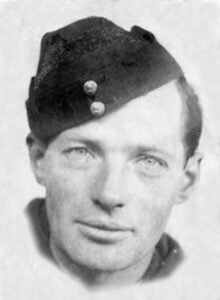
 Gordon Cummins1914–1942
Gordon Frederick Cummins was an active-duty Leading Aircraftman serving in the Royal Air Force (RAF) during the height of the Second World War.Stationed at an aircrew receiving center in Regent’s Park, Cummins projected the social persona of an elegant, aristocratic serviceman, often falsely telling peers that he was the illegitimate son of a noble lord. Behind this refined, confident military mask, however, lay an exceptionally explosive, sadistic sexual predator.
Criminological profiles categorize Cummins as a highly accelerated thrill-killer. Armed with a standard-issue service salary and funds obtained through localized thefts, he spent his nights drinking heavily in West End clubs before launching brutal attacks. His psychological pathology manifested as a deep, immediate compulsion to completely dominate, asphyxiate, and surgically mutilate his female targets, earning him historical comparisons to Jack the Ripper due to the extreme severity of his crimes.
Cummins’ operational pattern capitalized on the physical realities of wartime London. He targeted lone women walking through the pitch-black streets or commercial workers operating out of basement flats around Piccadilly and Marylebone. He used his crisp RAF uniform and smooth manners to seamlessly gain entry to his victims’ homes or draw them into secluded public alleyways.
His execution method was swift and devastatingly violent. He immediately used manual strangulation or improvised ligatures (like a silk scarf) to cut off his targets’ airways and prevent them from screaming into the dark. Once the victim was unconscious or dead, Cummins deployed various bladed items—including a standard service knife and a razor—to execute extensive post-mortem mutilations, deliberately staging the crime scenes to maximize the shock value for first responders.
- The Interrupted Assault: On the night of February 14, 1942, Cummins attacked his fifth target, Kathleen King, in a dark alleyway. The sudden approach of an unlit delivery vehicle startled Cummins, forcing him to flee into the shadows and leave his immediate victims behind.
- The Critical Service Number: Scotland Yard investigators processing the alleyway recovered a standard-issue military gas mask container dropped by the fleeing attacker. Stamped clearly on the canvas strap was the unique RAF service number: **1552529**, tracking directly back to Gordon Cummins.
- The Fingerprint Mirror: Chief Superintendent Frederick Cherrill, Scotland Yard’s legendary fingerprint master, processed items found across the multiple murder flats. Cherrill extracted flawless latent fingerprints left in blood on a cocktail glass and a mirror. The prints delivered an exact match to Cummins’ index finger, providing undeniable forensic proof that ended his six-day run.
February 9, 1942 // Evelyn Hamilton: A pharmacist is found strangled inside an air-raid shelter in Marylebone. Her handbag is looted, initiating the crime spree.
February 10, 1942 // Evelyn Oatley: Found manually strangled and severely mutilated with a razor inside her apartment on Wardour Street.
February 11, 1942 // Margaret Lowe: Murdered via silk-scarf ligature inside her flat in Paddington, suffering extreme post-mortem bladed trauma.
February 12, 1942 // Doris Jouannet: Found strangled and mutilated inside her ground-floor flat near Regent’s Park. Pathologists confirm identical tool signatures.
February 14, 1942 // The Survival Incidents: Cummins attempts to strangle Greta Hayward and Kathleen King within hours of each other, but is scared off, dropping his gas mask in his rush to escape.
February 16, 1942 // Tactical Arrest: Armed with the gas mask service number, police raid Cummins’ RAF quarters, seizing blood-stained banknotes and items stolen from the victims.
April 1942 // The Old Bailey Trial: Prosecuted under intense wartime secrecy to prevent a collapse in public morale, fingerprint evidence seals his conviction in just one day.
June 25, 1942 // Execution: Cummins is officially executed via hanging at Wandsworth Prison during an active German air raid, remaining completely indifferent to his sentence.
The case of Gordon Cummins represents a unique study in wartime information management. Fearing that news of an active, monstrous serial killer hiding within the ranks of the Royal Air Force would damage domestic morale and weaponize enemy propaganda during the height of the Blitz, the British Ministry of Information heavily managed the media coverage, limiting front-page reporting of the Old Bailey proceedings.
Historically, Cummins’ conviction stands as an absolute triumph for early fingerprint forensics. The rapid work of Superintendent Cherrill in capturing clear dactyloscopic impressions under chaotic, bombed-out wartime conditions proved that scientific tracking could outpace even the deepest physical cover of the London blackouts, providing a definitive blueprint for rapid multi-jurisdictional serial crime responses.
| Victim Name | Date | Context of Fatality |
|---|---|---|
| Evelyn Hamilton (40) | February 9, 1942 | Strangled inside a dark brick air-raid shelter in Marylebone; body looted of personal finances. |
| Evelyn Oatley (35) | February 10, 1942 | Former actress. Manually strangled and severely mutilated with a razor inside her Soho flat. Left-behind fingerprints secured a direct link to the killer. |
| Margaret Florence Lowe (43) | February 11, 1942 | Suffocated with a silk scarf inside her Paddington room; body subjected to extreme post-mortem bladed injuries. |
| Doris Jouannet (32) | February 12, 1942 | Strangled with a scarf inside the ground-floor home she shared with her husband near Regent’s Park; found by first responders next morning. |