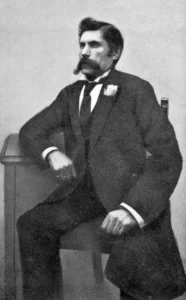
 George Chapman
Born Seweryn Kłosowski in Congress Poland, Chapman underwent formal training as a feldsher (a surgical assistant) before emigrating to London around 1887. Settling in Whitechapel, he initially found employment as a barber. To obscure his foreign origin and mask an increasingly volatile personal life—which included a complex web of bigamous marriages—he officially adopted the anglicized alias “George Chapman” in 1895.
Criminological evaluations highlight a profoundly sadistic, misogynistic personality configuration. Moving systematically across London as a publican, Chapman acquired common-law wives, coerced them into operating his leased public houses, and subsequently launched slow-poisoning campaigns against them. Uniquely for serial poisoners of the Victorian era, financial gain via life insurance fraud was secondary; his primary motivation appeared to be a psychopathic desire for absolute physical domination and control over his targets’ lingering deaths.
Chapman’s operational methodology was highly clinical and domestic. Utilizing his medical background, he purchased tartar emetic (an antimony-based metallic compound) from a chemist in Hastings. Because antimony is virtually tasteless, odorless, and highly soluble, Chapman was able to seamlessly introduce the toxin into communal beverages, medication mixtures, and brandy serves that he prepared for his partners.
He administered the poison in micro-doses over weeks or months, deliberately inducing a state of systemic gastrointestinal collapse. To local family doctors, Chapman projected the persona of an incredibly devoted, grieving husband, constantly attending the victims’ bedsides. This theatrical grief completely deflected suspicion, allowing him to secure official medical death certificates citing natural causes like intestinal inflammation or consumption, effectively neutralizing immediate policing intervention.
- The Final Suspicion: The sudden, agonizing death of Maud Marsh in October 1902 forced her family to demand an independent post-mortem. Hospital doctors quickly uncovered atypical toxicological indicators, triggering a wider police intervention.
- The Preservative Reality of Antimony: Following Chapman’s immediate arrest, Home Office pathologists ordered the exhumation of his previous two wives, Mary Spink and Bessie Taylor. Upon opening the coffins, investigators were stunned to find the remains almost perfectly preserved. Antimony acts as a highly potent natural embalming agent, preventing typical post-mortem microbial breakdown.
- The Stevenson Analysis: Renowned Home Office toxicologist Dr. Thomas Stevenson processed the preserved internal tissue samples using the Marsh and Reinsch tests. Stevenson successfully extracted massive, lethal concentrations of metallic antimony from all three victims, creating an ironclad forensic chain that shattered Chapman’s defense.
1887–1888 // Whitechapel Inception: Kłosowski arrives in London, establishing a barber shop under George Yard Buildings, placing him geographically adjacent to the core Jack the Ripper crime scenes.
December 25, 1897 // Mary Spink: Chapman’s first common-law wife dies after a prolonged, painful illness. Chapman inherits her small savings and acquires a public house lease.
February 13, 1901 // Bessie Taylor: Chapman’s second common-law partner succumbs to a identical gastric collapse pattern at his pub in Bishop’s Stortford.
October 22, 1902 // Maud Marsh: Despite her father’s aggressive medical interventions, Marsh dies from acute antimony poisoning at the George public house in Southwark.
October 25, 1902 // Tactical Arrest: Inspector Frederick Abberline and the Metropolitan Police arrest Chapman as he attempts to flee his public house compound.
March 1903 // The Old Bailey Trial: Prosecuted by the Solicitor General, Chapman is rapidly convicted of murder following Dr. Stevenson’s overwhelming toxicological testimony.
April 7, 1903 // Execution: Chapman is officially executed via hanging at Wandsworth Prison, remaining entirely silent regarding his true identity or his past crimes.
Following Chapman’s arrest, the legendary Scotland Yard detective Frederick Abberline openly stated his firm belief that the Borough Poisoner was the true identity of Jack the Ripper. Abberline pointed out that Chapman arrived in Whitechapel right before the 1888 killings began, possessed extensive surgical knowledge, matched the physical descriptions of the Ripper suspect, and was known to exhibit severe, explosive misogynistic rage toward women.
While modern forensic profilers frequently argue that serial offenders rarely switch their signature from open bladed mutilation to covert chemical poisoning, Chapman remains one of the most compelling historical suspects. His case profoundly reshaped late-Victorian pharmacy laws, leading directly to significantly stricter registry rules and tracking mandates for the commercial sale of bulk antimony compounds across the United Kingdom.
| Victim Name | Date | Context of Fatality |
|---|---|---|
| Mary Isabella Spink | December 25, 1897 | Common-law wife. Systematically poisoned via laced drinks at a lease property in Borough. Exhumation profile revealed complete chemical preservation. |
| Bessie Taylor | February 13, 1901 | Common-law wife. Targeted during their residency in Hertfordshire. Succumbed to an identical micro-dose antimony campaign. |
| Maud Marsh | October 22, 1902 | Barmaid and common-law partner. Murdered at the George public house in Southwark. The primary detection case that shattered the perpetrator’s evasion network. |