DONALD NEILSON (Born Nappey)
Sawn-off Shotgun / Ligature (Wire)
Midlands & Northern England
Sub-postmasters / Wealthy Targets (Ransom)
1974–1975
4 Confirmed Homicides
DECEASED // CLOSED
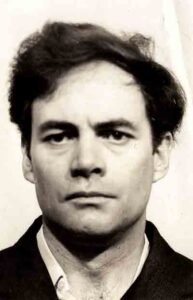
Donald Neilson was born Donald Nappey, a surname that brought him severe bullying in his youth. In 1960, he legally changed his name to Neilson. He was deeply obsessed with military discipline, having served in the National Service where he trained in jungle warfare. Though he failed to make a career in the armed forces, he adopted an extreme, survivalist mindset, viewing his criminal enterprises not merely as theft, but as tactical military operations.
Neilson began as a prolific cat burglar, committing an estimated 400 break-ins without detection. He transitioned into robbing small post offices, adopting his signature all-black attire and balaclava, which earned him the media moniker “The Black Panther.” His psychological profile demonstrated profound grandiosity, extreme ruthlessness when confronted, and an over-reliance on meticulously rigid planning that lacked the flexibility to adapt when real-world variables intervened.
1974 // The Postmaster Murders: Over ten months, Neilson’s post office robberies escalated to lethal violence. He shot and killed three sub-postmasters—Donald Skepper in Harrogate, Derek Astin in Baxenden, and Sidney Riley in Langley—when they attempted to resist or defend their families during his midnight home invasions.
January 14, 1975 // The Abduction: Seeking a massive payday, Neilson kidnapped 17-year-old Lesley Whittle from her home in Shropshire, leaving behind a ransom note demanding £50,000. He had read about a recent inheritance she received in a newspaper.
January – March 1975 // Bathpool Park: Neilson orchestrated a convoluted ransom drop using Dymo tape clues hidden across the Midlands. A catastrophic lack of police communication caused Lesley’s brother, Ronald, to miss the rendezvous. Spooked by unrelated police activity in Bathpool Park, Neilson abandoned the drop. On March 7, 1975, Lesley’s body was found hanging by a wire noose in a subterranean drainage shaft beneath the park, where Neilson had tethered her.
- Exhibit A (The Dymo Tape): Neilson used a Dymo label maker to create the ransom instructions, producing distinct, plastic punched lettering designed to avoid handwriting analysis.
- Exhibit B (The Subterranean Lair): The Bathpool Park drainage shaft. Neilson had heavily modified the narrow, 54-foot deep drop with a platform and sleeping bag, tethering Lesley by her neck to an iron stanchion to prevent her escape.
- Exhibit C (Ballistics): A customized, sawn-off 12-gauge shotgun utilized in the sub-postmaster murders and carried during the kidnap drop.
- Exhibit D (The Voice Recording): Neilson forced Lesley to record an audio message to her family as proof of life, which featured his own distinct, heavily commanding voice in the background, offering crucial dialectal clues.
Neilson’s methodology was defined by extreme stealth and physical agility. He targeted post offices with attached living quarters, breaking in during the dead of night. His “Black Panther” uniform consisted of dark clothing, plimsolls, and a black balaclava. He operated with military precision, moving silently in the dark to wake his victims at gunpoint.
During the Whittle kidnapping, his signature shifted to elaborate, highly rigid logistics. He designed a “treasure hunt” ransom drop requiring the victim’s family to drive between phone boxes and hidden tape messages. This complex system proved too fragile; when unexpected events occurred (such as a lost police patrol car inadvertently parking near the drop zone), Neilson’s inability to adapt led him to abandon the operation and his hostage entirely.
- Physicality: A short, highly athletic, and wiry man with a severe, intense demeanor. He possessed incredible stamina, capable of hiking miles cross-country with heavy equipment.
- The Arrest (December 1975): Neilson was not caught through deductive policing, but by sheer chance. Two patrol officers in Mansfield, Stuart Mackenzie and Tony White, stopped him for acting suspiciously. Neilson pulled a shotgun, hijacked their police car, and forced them to drive. A violent struggle ensued, and Neilson was finally subdued outside a fish and chip shop with the brave intervention of a civilian, Roy Morris.
- Interrogation Behavior: Defiant and contemptuous. He claimed the deaths were accidental, blaming the postmasters for resisting and absurdly arguing that Lesley Whittle accidentally fell from the shaft ledge.
- Custodial Resolution: Sentenced to five life terms in 1976. He remained a Category A prisoner until his death from respiratory complications at age 75 in December 2011.
Det. Chief Supt. Bob Booth: The lead investigator on the Whittle kidnapping. He faced intense public and media scrutiny. Following the catastrophic failure of the ransom drop and the discovery of Lesley’s body, Booth was unfairly scapegoated and demoted to uniformed patrol, a decision that remained controversial for decades.
Ronald Whittle: Lesley’s brother, who bravely attempted to follow Neilson’s terrifying and confusing ransom instructions alone in the dead of night. His efforts were thwarted by a tragic combination of poor directions, heavy fog, and police blunders.
The Black Panther case stands as one of the most disastrous examples of inter-agency police failure in British history. The investigation was severely hampered by territorial disputes between the West Mercia Police and Staffordshire Police. Crucial information was siloed, and radio communications were uncoordinated.
The tragedy directly forced a massive modernization of UK police operations. It led to the creation of the Police National Computer (PNC) to share data instantly across jurisdictions, and the establishment of standardized, centralized protocols for handling kidnappings and ransom drops, ensuring that no multi-force operation would ever be managed with such chaotic disorganization again.
The four confirmed murder victims of Donald Neilson. In addition to these fatalities, Neilson shot and severely wounded several other individuals during his crime spree.
| Victim Name | Status / Location | Date of Incident |
|---|---|---|
| Donald Skepper | Sub-Postmaster (Harrogate) | February 15, 1974 |
| Derek Astin | Sub-Postmaster (Baxenden) | September 6, 1974 |
| Sidney Riley | Sub-Postmaster (Langley) | November 11, 1974 |
| Lesley Whittle | Kidnapped (Found Bathpool Park) | January 14, 1975 |