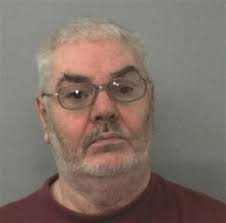
 David Burgess
David Burgess lived a highly localized existence in the village of Beenham, Berkshire. Following a severe childhood accident at age eight, Burgess lost his left eye, requiring him to wear a glass prosthetic that associates noted gave him a distinct, unnerving “staring” expression. Working as a farm laborer and heavy machinery operator at local gravel pits, Burgess was widely known in the community as an antisocial personality type, a heavy drinker who consumed upwards of twelve pints of Guinness an evening, and an exceptionally skilled poacher and rabbit snare trapper.
Criminological staging profiles indicate that Burgess possessed deep sadistic and predatory compulsions toward young girls and teenagers. His behavior post-offense was marked by extreme arrogance; he actively inserted himself into the investigation, chatting comfortably with tracking detectives, drinking with the fathers of his victims at the local Six Bells pub, and boasting to law enforcement that they “would have to prove it” if they ever wanted to hold him responsible for the village’s unresolved tragedies.
Burgess leveraged his complete, microscopic knowledge of Beenham’s geography to map out stalking routes. He targeted lone females traveling on foot at night or walking through unlit village lanes. His 1966 assault of teenage nanny Yolande Waddington occurred while she was posting a domestic letter, intercepting her en route and forcing her into an isolated, empty farmer’s barn known to locals as a secluded “courting couples” spot.
His methodology for execution was highly destructive, combining raw manual strangulation with erratic, deep stab wounds deployed via a standard pocket penknife. While his sharp-force actions frequently caused him to slip and cut his own fingers—thereby depositing his own blood directly onto the garments of his victims—the primitive nature of mid-century forensic testing allowed him to escape immediate detection. When targeting younger children in 1967, he used the pretext of rural exploration to lure them into deep, water-filled gravel excavations, executing them concurrently to minimize immediate witness detection.
- The 1967 Boot Extraction: Following the double homicide of Jeanette Wigmore and Jacqueline Williams, forensic testing identified that Wigmore possessed the exceptionally rare “AB/MN” blood type configuration, shared by a mere 1.5% of the UK population. Technicians successfully extracted matching AB/MN blood smears directly from Burgess’s right boot, securing his initial conviction.
- Early Village Mass Screening: During the 1966 Waddington case, Berkshire police executed one of the first mass scientific serology screenings in criminal history, blood-testing over 250 male residents between ages 15 and 50. While Burgess’s sample matched in three out of four parameters, primitive testing limits fell short of a conclusive match, allowing him to evade charges for that specific crime.
- The One-In-A-Billion Cold Case Match: In 2011, Thames Valley Police cold-case technicians re-analyzed stored historical items from the 1966 crime scene, including a plastic fertilizer sack and a hairband. Applying modern Short Tandem Repeat (STR) DNA amplification, scientists generated a pristine genetic profile. The profile matched Burgess with a statistical significance showing a less than 1-in-a-billion chance of matching an unrelated individual, forcing a final conviction 46 years late.
January 1963 // Precursor Assault: At just fourteen years old, Burgess stalks a young female resident returning from a public telephone kiosk, executing a physical assault before fleeing the area.
October 28, 1966 // Yolande Waddington: A 17-year-old family nanny is intercepted, stabbed, and strangled inside an isolated Beenham barn. Burgess undergoes primitive mass blood screening but evades initial indictment.
April 17, 1967 // The Blake’s Pit Double Homicide: Burgess lures nine-year-olds Jeanette Wigmore and Jacqueline Williams into an isolated gravel pit. He murders both girls via strangulation and knife trauma, stashing their bodies in a deep ditch.
July 21, 1967 // Double Life Conviction: Following a brief trial at Gloucester Assizes where his “MacNab” alibi is exposed as entirely fictional, a jury convicts Burgess. He is handed two concurrent life sentences.
1969 // The Jailhouse Confessions: While held inside Durham High-Security prison, Burgess repeatedly boasts to correctional wardens and fellow inmates that he killed Waddington, taunting visiting detectives to prove it.
2011 // Forensic Re-Analysis: Under cold-case protocols, scientists extract high-tier STR DNA from preserved 1966 crime scene packaging, creating a flawless match to Burgess’s profile entry.
July 20, 2012 // Final Adjudication: Forty-six years after the initial offense, Reading Crown Court finds Burgess guilty of the murder of Yolande Waddington, issuing a consecutive 27-year minimum life order to ensure his permanent containment.
The case of David Burgess and the Beenham village crimes left a lasting mark on the historical evolution of British forensic field tactics. The 1966 village-wide blood screen stood for decades as a groundbreaking precursor to modern mass DNA intelligence screening sweeps (pioneered later by Colin Pitchfork’s tracking case in 1987), demonstrating how early police forces attempted to use localized biochemistry to eliminate geographic blind spots.
Furthermore, Burgess’s subsequent 2012 trial stands as an extraordinary benchmark for British cold-case litigation, showcasing the extreme durability of physical trace evidence when properly archived. The successful extraction of viable, un-degraded DNA material from low-grade materials like a plastic fertilizer sack after more than four decades delivered a powerful warning to long-term undetected offenders, proving that advances in forensic sensitivity can systematically dismantle decades of calculated evasion.
| Victim Name | Date | Context of Fatality |
|---|---|---|
| Yolande Waddington (17) | October 28, 1966 | Children’s nanny targeted while walking at night. Suffered internal asphyxiation and chest stab wounds inside an isolated agricultural barn. Conviction secured via cold-case DNA in 2012. |
| Jeanette Wigmore (9) | April 17, 1967 | Village schoolchild lured into Blake’s Pit excavations. Manually strangled and cut; rare blood type linked directly to the killer’s boot. |
| Jacqueline Williams (9) | April 17, 1967 | Companion of Jeanette Wigmore. Murdered concurrently via severe neck compression and blunt-force trauma to eliminate immediate witness detection. |