CHARLES STARKWEATHER & CARIL ANN FUGATE
.22 Caliber Rifle / .410 Shotgun / Knives
Nebraska & Wyoming, USA
Targeted Family / Opportunistic Civilians
Nov 30, 1957 – Jan 29, 1958
11 Confirmed Homicides
EXECUTED (STARKWEATHER) // PAROLED (FUGATE)
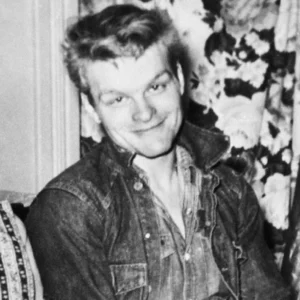 Charles Starkweather
Charles Starkweather was a 19-year-old garbage collector from Lincoln, Nebraska. He suffered from profound social alienation, exacerbated by severe bullying in his youth due to a speech impediment and bowed legs. To compensate, he developed a rigid, aggressive persona, heavily modeling his appearance and attitude on the actor James Dean. He harbored a deep-seated fatalism and believed he was destined for a short, violent life.
His psychological anchor became 13-year-old Caril Ann Fugate (14 at the time of the primary spree). When Fugate’s family vehemently opposed the relationship and attempted to separate them, Starkweather’s smoldering resentments ignited into homicidal rage. The extent of Fugate’s willing participation versus coerced captivity remains one of the most hotly debated elements of the case in American criminal history.
November 30, 1957 // The Catalyst: Operating alone, Starkweather commits his first murder. After a dispute over a stuffed animal at a service station, he returns with a shotgun, forces attendant Robert Colvert into his vehicle, drives him to a remote area, and executes him.
January 21, 1958 // The Familial Annihilation: Starkweather arrives at Fugate’s home in Lincoln. After a confrontation, he shoots her stepfather, Marion Bartlett, and her mother, Velda, before fatally striking Fugate’s two-year-old half-sister, Betty Jean. Chillingly, Starkweather and Fugate remain living in the house with the bodies for six days, turning away visitors by pinning a note to the door claiming the family has the flu.
January 27–28, 1958 // The Escalation & Panic: Fleeing the house, the pair drive to the farm of August Meyer, a family friend, whom Starkweather murders. Their vehicle gets stuck in mud; they abandon it and hijack teenagers Robert Jensen and Carol King. Starkweather murders them both in a storm cellar. Returning to Lincoln, they invade the wealthy home of C. Lauer Ward, murdering his wife Clara, maid Lillian Fencl, and eventually Ward himself when he returns home. This triggers mass hysteria; the Governor of Nebraska calls out the National Guard, and vigilante posses form across the region.
January 29, 1958 // Wyoming Capture: Driving Ward’s stolen Packard into Wyoming, Starkweather murders traveling salesman Merle Collison to steal his vehicle. A passing motorist and a deputy sheriff intervene. Following a high-speed chase, a bullet shatters Starkweather’s windshield. Believing he is bleeding to death from a minor glass cut, he stops and surrenders. Fugate runs to an approaching officer, claiming Starkweather held her hostage.
- Exhibit A (The Flu Note): A handwritten note placed on the door of the Bartlett residence, actively deceiving neighbors and extending the timeline of the initial concealment, strongly suggesting Fugate’s complicity in covering up the murders.
- Exhibit B (Starkweather’s Changing Confessions): Starkweather initially claimed full responsibility and stated Fugate was a hostage. He later repeatedly changed his testimony, eventually claiming she was a willing participant and had actively killed several of the victims herself.
- Exhibit C (The Stolen Vehicles): The spree heavily relied on sequential vehicle hijackings. The Ward family’s Packard became a critical identifier that allowed authorities to track their movement across state lines.
Starkweather’s modus operandi was characterized by extreme disorganization, resource acquisition via murder, and a high degree of overkill. He transitioned rapidly between victim profiles: from targeted grievance killings (Fugate’s family) to crimes of opportunity for transportation (Jensen, Ward, Collison) and resources.
The forensic signature exhibited profound rage and sadism. Many victims were subjected to blunt force trauma or knife wounds even after being fatally shot, indicating that the murders were not strictly utilitarian (for robbery) but served a deep psychological need to exert ultimate control and dominance over his victims.
- Charles Starkweather: Convicted of murder and sentenced to death. Despite multiple appeals, he was executed in the electric chair at the Nebraska State Penitentiary on June 25, 1959. He was 20 years old.
- Caril Ann Fugate: Tried and convicted of first-degree murder, her defense that she was a terrified hostage was undermined by witness testimony and her failure to flee when opportunities arose. She became the youngest female in US history to be tried for first-degree murder.
- Custodial Resolution (Fugate): Sentenced to life imprisonment at the Nebraska Correctional Center for Women. A model prisoner, she was paroled in 1976 after serving 17 years. She has maintained her innocence regarding direct participation in the murders to this day.
The Starkweather-Fugate case shattered the post-war innocence of Middle America. It was one of the first times mass media heavily televised a live, multi-state manhunt, creating an unprecedented climate of regional terror. The image of the “teenage rebel” morphed instantly from a Hollywood trope into a real-world, lethal threat.
The cultural footprint of the spree is massive. Starkweather’s nihilistic violence directly inspired numerous cinematic interpretations, most notably Terrence Malick’s Badlands (1973), Oliver Stone’s Natural Born Killers (1994), and Bruce Springsteen’s critically acclaimed 1982 album Nebraska. The psychological dynamic between Starkweather and Fugate remains a premier case study in folie à deux (shared psychosis) and the complexities of coercive control in criminal partnerships.
The 11 victims whose lives were claimed during the chaotic two-month period:
| Victim Name | Age | Location / Relationship |
|---|---|---|
| Robert Colvert | 21 | Lincoln, NE (Gas Station Attendant) |
| Marion Bartlett | 57 | Lincoln, NE (Fugate’s Stepfather) |
| Velda Bartlett | 36 | Lincoln, NE (Fugate’s Mother) |
| Betty Jean Bartlett | 2 | Lincoln, NE (Fugate’s Half-Sister) |
| August Meyer | 70 | Bennet, NE (Family Friend) |
| Robert Jensen | 17 | Bennet, NE (Motorist / Hijacking) |
| Carol King | 16 | Bennet, NE (Motorist / Hijacking) |
| C. Lauer Ward | 47 | Lincoln, NE (Industrialist / Home Invasion) |
| Clara Ward | 46 | Lincoln, NE (Home Invasion) |
| Lillian Fencl | 51 | Lincoln, NE (Ward Family Maid) |
| Merle Collison | 34 | Douglas, WY (Traveling Salesman) |