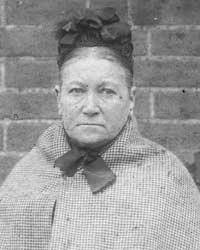
 Amelia Dyer
Born in Bristol, Amelia Dyer was well-educated for her era and formally trained as a nurse, a role that granted her extensive insights into obstetrics and the underground economy of Victorian childbirth. Following the death of her husband in 1869, Dyer sought a highly lucrative income stream and turned to “baby farming”—the practice of taking in illegitimate infants from desperate mothers or workhouses in exchange for a one-off premium or ongoing child-support stipends.
Behind her grandmotherly, deeply pious exterior lay a cold, highly manipulative commercial killer. Throughout her thirty-year career, whenever local coroners grew suspicious of the sheer volume of infant fatalities occurring under her roof, Dyer would leverage a history of substance abuse to deliberately commit herself to local lunatic asylums. This tactical utilization of the Victorian mental health infrastructure disrupted active police inquiries, cleansed her background record, and allowed her to relocate to new towns to seamlessly resume her operations under a web of aliases.
Duffy’s early operational methodology relied on systematic, passive neglect. After securing custody of an infant along with an up-front payment of £10 to £80 (a fortune at the time), Dyer would completely starve the child while heavily sedating them with “Mother’s Friend”—a lethal, mass-marketed liquid mixture of opium and laudanum. This kept the starving infants silent until they succumbed to marasmus or exhaustion, enabling friendly, corrupt doctors to issue standard death certificates citing natural causes or structural weakness.
As her career progressed and she sought to maximize profit margins by bypassing medical fees and avoiding death registrations altogether, Dyer escalated to active, immediate execution. Her refined method involved wrapping half-inch white cotton dressmaking tape tightly around the infant’s neck, ensuring rapid asphyxiation. She then packed the corpses tightly into heavy carpet bags, weighted them heavily with bricks or slag material, and threw the bundles directly into the River Thames, assuming the water transit would wash away all physical links to her household.
- The Bargeman’s Catch: On March 30, 1896, a cargo bargeman operating along the River Thames at Reading hooked a submerged, heavy carpet bag out of the water. Upon opening the package, authorities discovered the wrapped, decomposing remains of an infant girl later identified as Helena Fry.
- The Waterlogged Paper Trace: Reading borough police detectives carefully dried out the water-damaged wrapping paper found lining the interior of the bag. Under specific side-lighting, technicians isolated a faint, handwritten ink inscription detailing an address: **”Mrs. Thomas, 26 Pigotts Road, Caversham.”**
- The Sting Operation: Chief Constable George Tewsley used this address to identify Dyer’s primary processing hub. Police deployed an undercover female operative to arrange an adoption appointment. When Dyer opened her door to receive the fictitious infant, detectives launched a raid, uncovering massive quantities of white dressmaking tape, pawn tickets for infants’ garments, and classified letters from hundreds of desperate mothers, breaking her evasion network completely.
1869–1879 // Operational Inception: Following her husband’s death, Dyer establishes a baby farming business in Bristol, utilizing laudanum sedation to thin out her charges.
1879 // The Manslaughter Conviction: A suspicious doctor reports the sheer number of infant deaths in her care. Dyer is prosecuted but receives just six months of hard labor for neglect, a lenient sentence she attributes to mental instability.
1880–1895 // Asylum Evations & Relocations: Dyer transitions to active strangulation to accelerate her turnover. To escape mounting police interest, she repeatedly commits herself to Wells and Marlborough asylums before emerging under new aliases.
March 1896 // The Fry & Palmer Executions: Dyer takes custody of newborns Helena Fry and Doris Marmon, executing both within hours using white cotton tape, packing them into a single weighted bag, and dropping them into the Thames.
March 30, 1896 // The River Breach: The weighted bag is pulled from the river by a bargeman, exposing the paper trace that leads directly to her Caversham cottage.
April 3, 1896 // Tactical Arrest: Police raid her home, discovering the distinct aroma of human decomposition alongside miles of identical edging tape. River police subsequently dredge the Thames, recovering more weighted infants.
May 1896 // The Old Bailey Trial: Pleading insanity based on her asylum history, the prosecution presents her detailed financial ledgers, demonstrating a completely calculating business model. The jury convicts her in under five minutes.
June 10, 1896 // Execution: At exactly 9:00 AM, Dyer is officially executed via hanging at Newgate Prison, making her the oldest woman executed in Britain during the Victorian era.
The horrifying exposure of Amelia Dyer’s systematic infanticide campaign shattered the complacency of Victorian society regarding underground childcare networks. The realization that hundreds of infants had been industrial-scaled for murder solely to collect small adoption premiums forced Parliament to dramatically alter national child welfare legislation.
Her case served as the direct catalyst for the implementation of the **Infant Life Protection Act of 1897**. This landmark statute stripped baby farming rings of their legal shield by requiring local authorities to strictly register, routinely inspect, and legally track all foster situations involving more than one infant under the age of five. This laid the structural foundation for the modern, state-vetted adoption and child fostering frameworks used across the United Kingdom today.
| Victim Name | Date | Context of Fatality |
|---|---|---|
| Helena Fry | March 1896 | Illegitimate child of a servant girl. Strangled with cotton dressmaking tape; body recovered from the Thames inside the waterlogged bag that broke the case. |
| Doris Marmon (4 mos) | March 31, 1896 | Adopted for a premium of £10. Strangled immediately in a transit vehicle; body recovered by police divers from the riverbed near Reading. |
| Harry Simmons (13 mos) | March 31, 1896 | Executed concurrently alongside Doris Marmon. Bound with identical edge tape and weighted with heavy bricks within a single processing bag. |