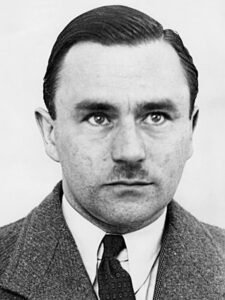
John George Haigh projected the image of a polished, well-dressed gentleman, frequently posing as an affluent engineer or company director while concealing a history of fraud and sociopathic manipulation. Raised within a strict religious background, Haigh developed deep-seated psychological fantasies involving blood and ingestion during his youth, which later evolved into calculated predatory schemes targeting acquaintances for financial liquidity.
Psychologically, Haigh exhibited grandiose narcissism and a chilling detachment from human life. Post-arrest psychiatric evaluations revealed a sophisticated awareness of his actions coupled with profound delusions regarding legal loopholes—specifically believing that total physical destruction of a corpse rendered criminal conviction legally impossible.
Haigh’s methodology integrated financial fraud with systematic chemical disposal. He cultivated relationships with vulnerable property owners or wealthy acquaintances, gaining their trust before luring them to isolated locations—such as a derelict workshop he rented in Crawley, West Sussex. Once inside, he incapacitated or shot victims with a firearm.
Following the homicide, Haigh stripped the body of valuables, placed the remains into a standard 40-gallon industrial carboy drum, and filled it with concentrated sulphuric acid. Over the course of 24 to 48 hours, the acid completely dissolved human tissue and bones into a sludge-like residue, which he poured away into drainage systems before forging legal documents to liquidate the victims’ assets.
- The Undissolved Evidence: When police investigated the disappearance of Olivia Durand-Deacon, forensic pathologizing of the debris outside Haigh’s workshop uncovered human gallstones, plastic-handled items, and denture fragments that sulphuric acid failed to dissolve.
- Dental Identification: Forensic odontologists positively matched the recovered acrylic and gold denture fragments to dental records of the missing victim, destroying Haigh’s “no body, no murder” defense.
- Documentary Trail: Police recovered pawn tickets, forged share transfers, and dry-cleaning receipts linking Haigh directly to the victims’ missing property.
1944 // William McSwan: Haigh murders his employer and benefactor in London, disposing of the body in acid to take over his properties and assets.
1945 // Donald and Amy McSwan: Haigh lures William’s elderly parents to his workshop and disposes of both bodies sequentially to prevent inquiries.
1947 // Archibald and Rosalie Henderson: A wealthy couple targeted for their car and possessions, similarly dissolved in industrial acid drums.
February 18, 1949 // Olivia Durand-Deacon: A wealthy widow residing at the same Kensington hotel as Haigh is lured to Crawley and murdered for her valuable jewelry.
February 28, 1949 // Tactical Arrest: Police suspicions triggered by hotel missing person reports lead to Haigh’s apprehension and the search of his workshop.
August 10, 1949 // Wandsworth Execution: Following a high-profile trial at Lewes Assizes where forensic science dismantled his legal defense, Haigh is executed by hanging.
The case of John George Haigh permanently reshaped criminal jurisprudence and forensic pathology in the United Kingdom. His trial effectively dismantled the historical misconception that a murder conviction required the recovery of a whole human body, proving that microscopic fragments, dental acrylics, and chemical residue could legally establish corpus delicti.
The investigation also highlighted the dangers surrounding unregulated industrial chemical sales during post-war Britain, prompting tighter oversight on hazardous substances and acid acquisitions used by commercial workshops.
| Victim Name | Date | Context of Fatality |
|---|---|---|
| William McSwan | 1944 | Employer. Murdered and dissolved in an acid bath to seize properties and financial assets. |
| Donald & Amy McSwan | 1945 | Parents of William McSwan. Lured to the workshop and eliminated to prevent investigation into their son’s disappearance. |
| Archibald & Rosalie Henderson | 1947 | Affluent couple targeted for their vehicle, possessions, and money before chemical dissolution. |
| Olivia Durand-Deacon | February 18, 1949 | Wealthy hotel acquaintance. Murdered for jewelry; undissolved denture fragments led directly to Haigh’s arrest. |