ANDERS BEHRING BREIVIK
ANFO VBIED (Car Bomb) / Semi-Automatic Firearms
Oslo & Utøya Island, Norway
Government Infrastructure / AUF Youth Camp
July 22, 2011
77 Confirmed Homicides (319+ Injured)
INCARCERATED // PREVENTIVE DETENTION
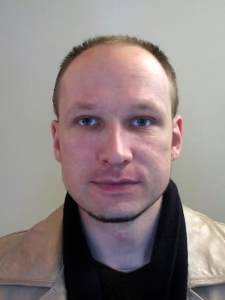 Anders Behring Breivik
Anders Behring Breivik was a 32-year-old Norwegian lone-wolf domestic terrorist driven by extreme far-right, Islamophobic, and ultranationalist ideologies. For years leading up to the attack, he lived a largely isolated existence, funding his operational planning through credit card fraud and the sale of fake academic diplomas while meticulously outlining his worldview in a massive, 1,500-page manifesto entitled 2083: A European Declaration of Independence.
Breivik’s pathology represents a chilling convergence of narcissistic grandiosity and political extremism. He viewed himself as a modern-day “Knights Templar” tasked with saving Europe from multiculturalism, cultural Marxism, and Islamic demographic integration. He specifically targeted the ruling Norwegian Labour Party, striking their government headquarters and their youth wing’s summer camp to actively exterminate the next generation of the country’s political leadership.
15:25 (3:25 p.m.) // The Regjeringskvartalet Bombing: Breivik parked a rented Volkswagen Crafter van containing a 950 kg (2,090 lb) ANFO explosive device directly outside the executive government quarter in Oslo. He ignited a fuse and fled in a getaway vehicle. The subsequent detonation killed 8 people, injured over 200, and severely damaged the Prime Minister’s office, plunging the capital into chaos.
17:22 (5:22 p.m.) // The Utøya Infiltration: Disguised in a meticulously crafted, counterfeit police tactical uniform and carrying heavily laden bags of weaponry and ammunition, Breivik arrived at the ferry landing for Utøya island. He exploited the ongoing panic in Oslo, claiming he was a police officer sent to secure the AUF youth camp following the bombing.
17:26 (5:26 p.m.) // The Island Massacre: Upon reaching the island, Breivik immediately executed the camp guard and organizer. He then moved methodically across the small island, hunting the trapped teenagers. He lured victims out of hiding by continuing to claim he was police, executing them at close range. For 72 minutes, he operated completely unchallenged, killing 69 people.
18:27 (6:27 p.m.) // Surrender to Delta: Norway’s elite emergency response unit (Delta) finally reached the island via civilian boats, as police helicopters were unavailable. Upon seeing the tactical team, Breivik immediately dropped his weapons and surrendered with his hands above his head, demanding to be treated as a political prisoner.
- Exhibit A (The Manifesto): Hours before the bombing, Breivik emailed his compendium, detailing his operational logistics, explosive recipes, and extremist ideology to 1,003 email addresses, securing his ideological legacy before his capture.
- Exhibit B (The Front Company): Breivik established a fake agricultural company (“Breivik Geofarm”) as a legal cover to purchase massive quantities of ammonium nitrate fertilizer, the primary component of his VBIED, without triggering domestic security alerts.
- Exhibit C (The Arsenal): He legally acquired a Ruger Mini-14 semi-automatic rifle and a Glock 34 pistol. He utilized expanding, hollow-point and frangible ammunition to ensure maximum internal tissue damage to the victims on Utøya.
- Exhibit D (The Police Disguise): The counterfeit uniform, complete with forged ID badges and a fake tactical patch, was his most critical psychological weapon, freezing the initial defense responses on the island and drawing terrified victims directly into his line of fire.
Breivik’s signature was one of absolute, unyielding tactical discipline combined with horrific betrayal. The dual-pronged attack utilized a classic “draw and strike” military tactic. The massive bomb in Oslo was both a primary target and a functional diversion, successfully paralyzing Norway’s emergency command structure and draining tactical resources away from his secondary, highly vulnerable target.
On the island, his behavior was clinical rather than frenzied. He fired single, aimed shots to conserve ammunition, frequently executing the wounded with point-blank shots to the head. Unlike many mass shooters who fight to the death or commit suicide, Breivik’s ultimate goal was the courtroom. He surrendered peacefully to guarantee a global platform from which to broadcast his ideological manifesto during his trial.
- Psychiatric Evaluation Debate: The initial forensic psychiatric evaluation diagnosed Breivik with paranoid schizophrenia, which would have meant confinement in a psychiatric ward. Amid massive public outcry and Breivik’s own objections, a second evaluation concluded he possessed narcissistic and antisocial personality disorders but was not psychotic, rendering him legally culpable.
- Courtroom Behavior: During his 2012 trial, he frequently gave extreme right-wing, clenched-fist salutes, smirked during horrific witness testimonies, and complained about a paper cut he received on his finger from a skull fragment of one of his victims.
- Custodial Resolution: In August 2012, Breivik was found sane and guilty of mass murder and terrorism. He was sentenced to 21 years of forvaring (preventive detention)—the maximum civilian penalty in Norway—which can be extended indefinitely as long as he remains a threat to society. He is currently held in near-total isolation at Ringerike Prison.
The July 22 attacks profoundly traumatized Norway, shaking the foundation of its open, high-trust society. The subsequent government-appointed Gjørv Commission (22 July Commission) delivered a scathing, 482-page indictment of the Norwegian police and intelligence services. The report concluded that the Oslo bombing could have been prevented had existing security measures been implemented, and that the police response to Utøya was unacceptably delayed due to catastrophic communication failures and the lack of an available police transport helicopter.
The disaster forced a complete paradigm shift in Norwegian domestic security. The national police director resigned, tactical response protocols for “active shooters” were radically rewritten to mandate immediate intervention by the first arriving officers rather than waiting for specialized units, and strict new limitations on the acquisition of semi-automatic firearms and certain fertilizers were heavily codified into national law.
A representative sample highlighting the 77 victims of the dual terror attacks, demonstrating the devastating impact across the government sector and the massive loss of youth on Utøya:
| Victim Name | Age | Location of Death |
|---|---|---|
| Hanne Ekroll Løvlie | 30 | Oslo Government Quarter |
| Jon Vegard Lervåg | 32 | Oslo Government Quarter |
| Trond Berntsen | 51 | Utøya (Off-duty Police / Camp Guard) |
| Sharidyn Svebakk-Bøhn | 14 | Utøya Island |
| Mona Abdinur | 18 | Utøya Island |
| Bano Rashid | 18 | Utøya Island |
| Simon Sæbø | 18 | Utøya Island |
| *Plus 70 additional victims | N/A | Across Oslo and Utøya |